The Shortcut
Immigration is National Interest
Finland urgently needs foreign talent to sustain its economy, welfare state and competitiveness. Yet public attitudes toward immigration remain cautious and often polarised. The national conversation has long been fragmented; dominated by emotion, myths and siloed actors without a credible force capable of uniting businesses, institutions and civil society behind a shared, positive vision for labor immigration.
A small non-profit organisation, The Shortcut, succeeded in doing exactly that.
Bringing together nearly 30 companies, universities, trade unions and organisations, The Shortcut launched a bold attitude-changing campaign during the municipal elections, reframing immigration not as an ideological issue, but as a matter of national interest.
Starting point
The Finnish public debate on immigration has traditionally been fragmented and siloed. There has been a lack of a unifying actor capable of bringing together established companies, startups, trade unions, universities, and civil society organisations to advocate for positive, labor immigration.
To address this gap and at the same time increase its own visibility, The Shortcut decided to build such a collective to launch an attitude-changing campaign during the municipal election period.
The goal was to create a campaign that would:
a) Unite diverse, cross-sector actors in support of labor immigration.
b) Bring The Shortcut’s work more broadly into public awareness within Finnish society.
c) Generate attention while also aiming to steer the highly polarized immigration debate toward a more constructive and fact-based direction.
Approach
Our insight was built on the combination of three mutuallyreinforcing elements: undeniable facts, the redefinition of Finnish national symbols, and social proof.
1. First, we anchored the debate in facts. In Finland, immigration has long been discussed through myths and emotional reactions. We deliberately reversed this dynamic by stepping away from emotional arguments and focusing instead on simple, verifiable truths: facts that are difficult to dispute. For example, Finland will need at least 130,000 new workers by 2030 due to an ageing population, and many iconic Finnish companies and industries were founded or shaped by foreign entrepreneurs and talent.
2. We reinterpreted Finnish national symbols. The lion,the blue cross flag and the national anthem had increasingly been appropriated by anti-immigration movements as symbols of isolation and closed borders. Our goal was to reclaim their original meaning: openness, internationalism and shared success; the very foundations of Finland’s history.
3. We leveraged social proof. People are more likely to believe and act when they see others doing the same. By bringing well-known companies and organisations into the campaign, we didn’t just increase reach, we added credibility and positioned the message as a matter of national competitiveness rather than ideology.
Together, these elements formed a powerful and credible message: Finland is not a closed country. Our success has always been built on openness.
This led to a bold and simple core idea: “Immigration is national interest.”
The line in Finnish “Maahanmuutto on maan puolustusta” connected two values deeply important to Finns: defending the nation and safeguarding the welfare state. Campaign showed that just as Finland’s independence has historically relied on international support, its future depends on global talent. As the population ages, immigration is not a threat, but a prerequisite for a competitive, secure and prosperous Finland.
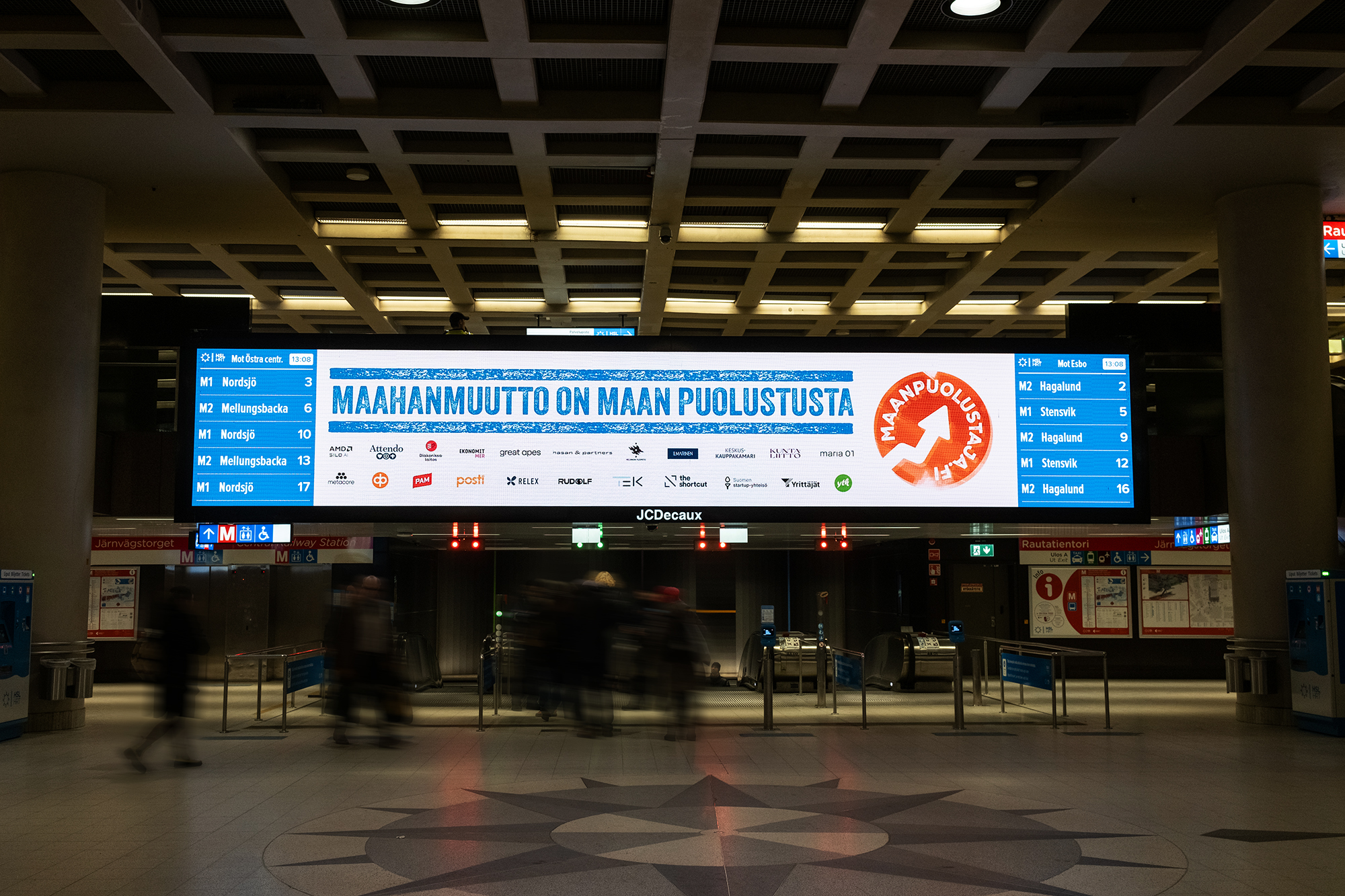
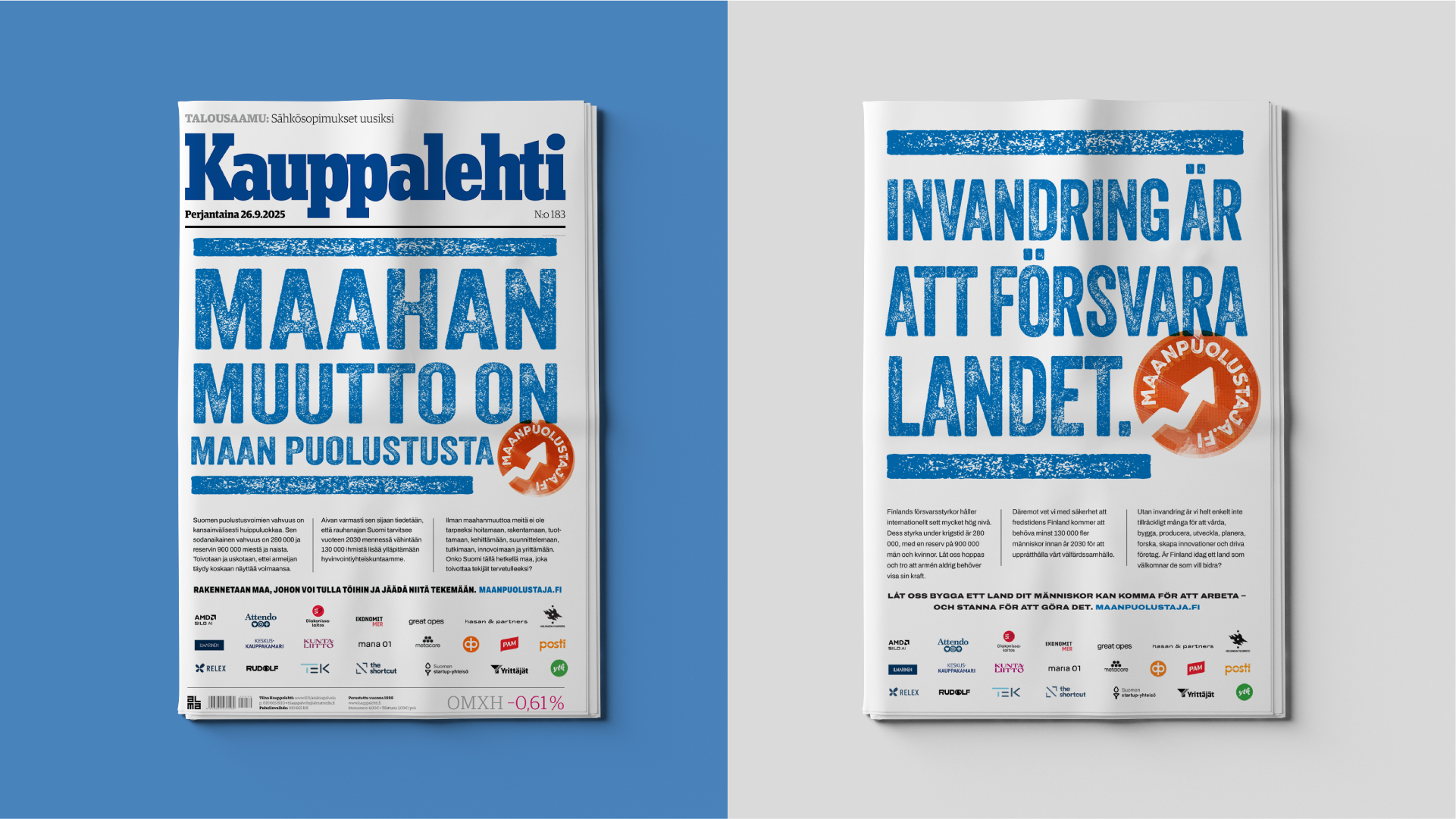
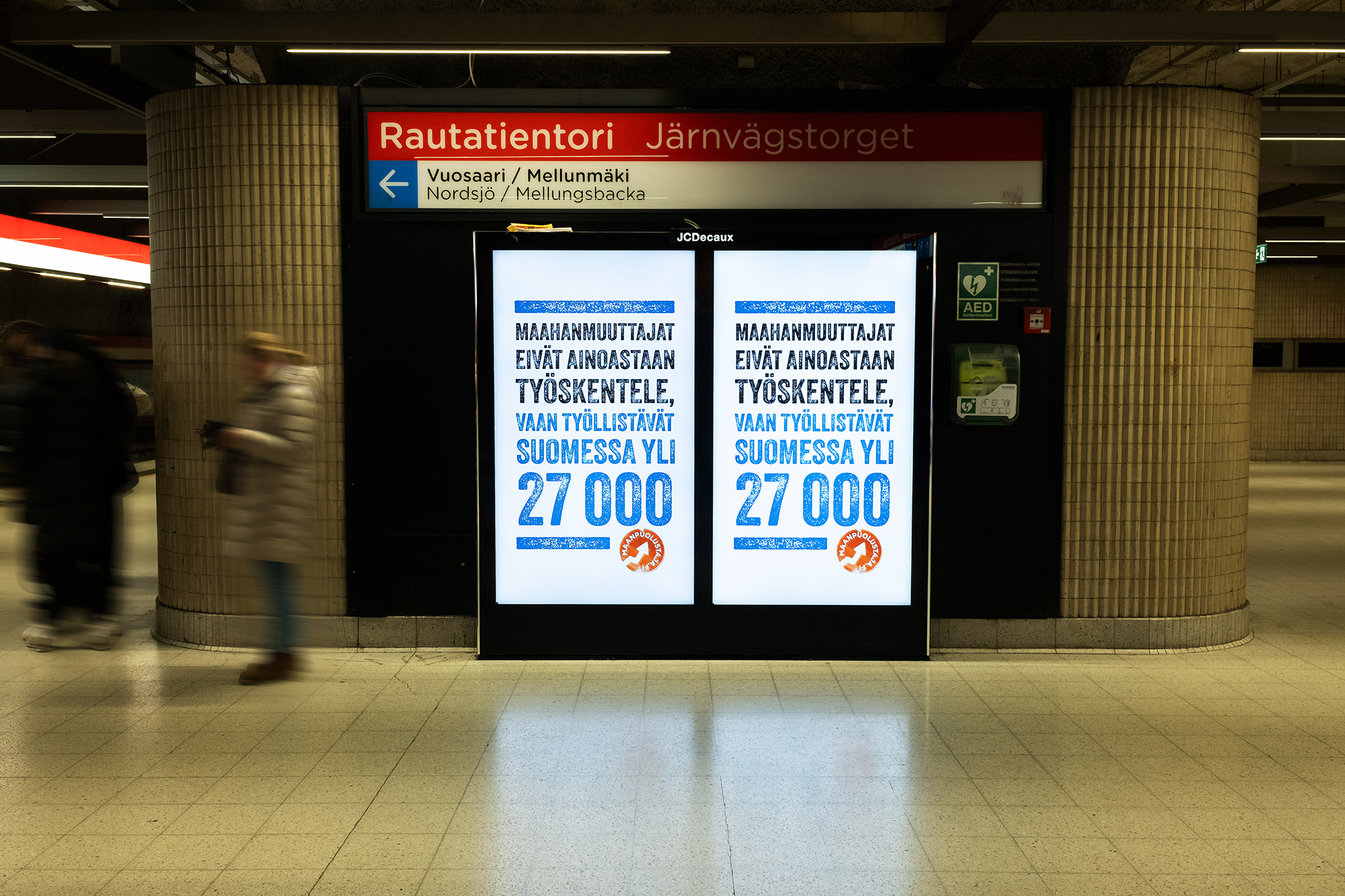
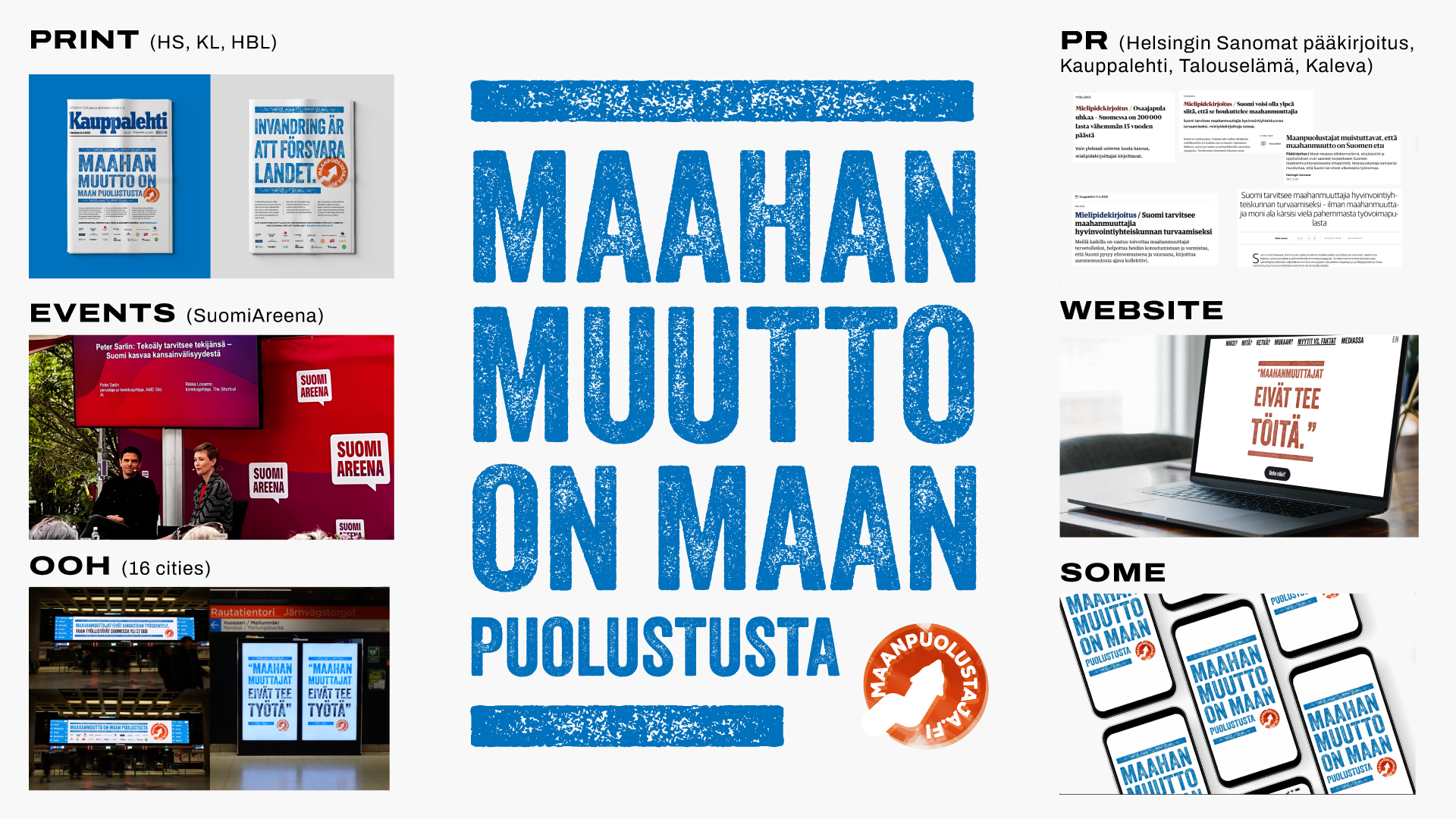
“Immigration is national Interest” was a campaign in which media strategy was absolutely central. Its core idea was to focus on a few carefully selected channels capable of generating maximum attention: full-page print ads in Helsingin Sanomat, Kauppalehti and Hufvudstadsbladet, combined with large-scale outdoor advertising across 16 cities.
These placements became the story themselves and continued to live on through social media. Paid media was only the starting point: people photographed and shared the ads thousands of times, journalists picked them up, and heated public debate followed.
Impact
Overall, the campaign reached 35.29 million people.
The total value of earned media (PR and public discussion) was almost €400,000.The campaign was discussed in all the major media outlets multiple times and caused lively debate on social media.
In the 2025 municipal elections, a record number of immigrant-background candidates were elected.
Awards
2026 Effie Finland Shortlist (Media idea)
2026 GrandOne Shortlist (Positive Change)
Collaborators
Awards
2026 Effie Finland Shortlist (Media idea)
2026 GrandOne Shortlist (Positive Change)